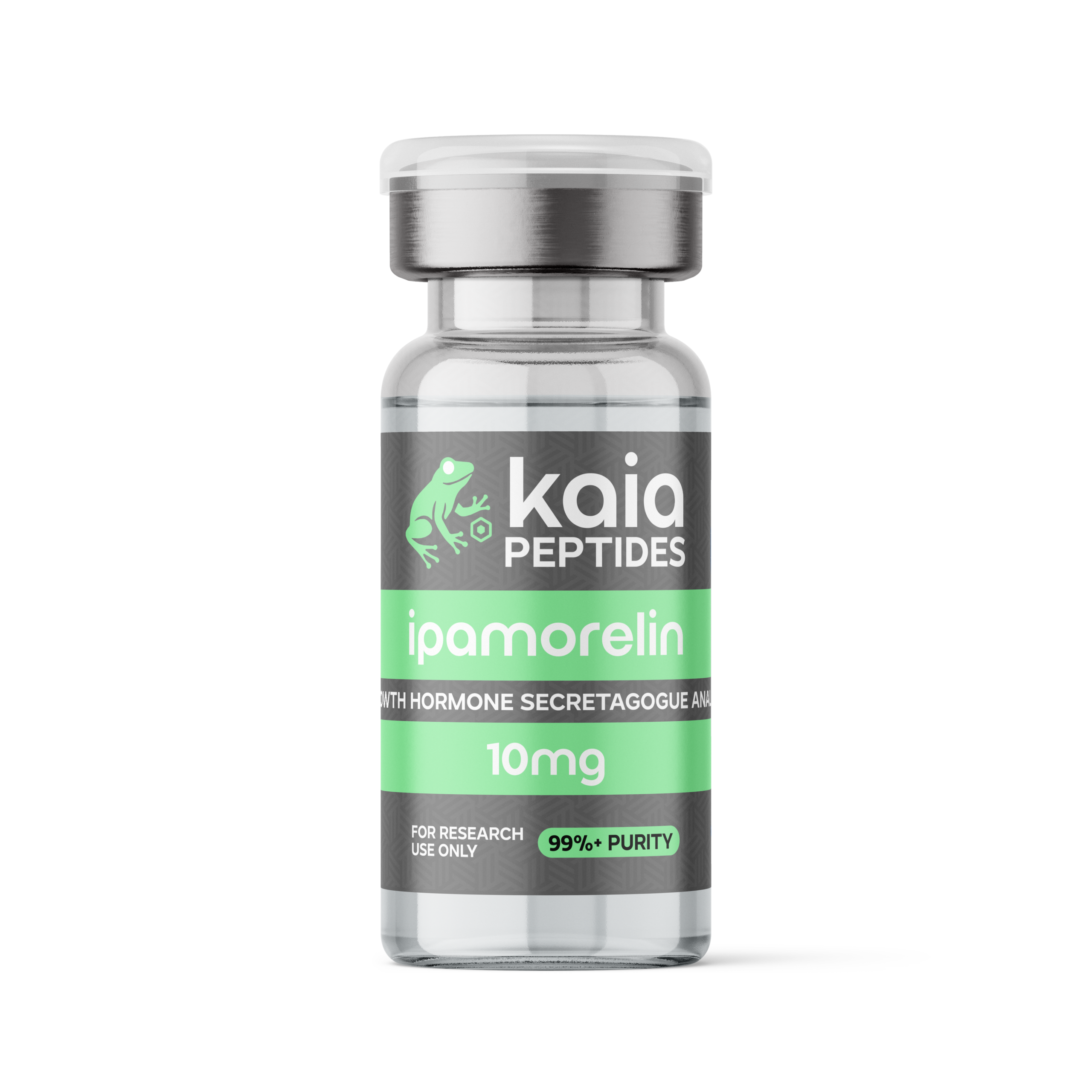
Ipamorelin (10mg)
Selective GH Secretagogue – GH Pulse Modeling, Tissue-Response Studies & Sleep-Phase Signal Research
For laboratory research use only. Not for human or animal use. These products have not been evaluated by the U.S. Food and Drug Administration (FDA) and are not intended to diagnose, treat, cure, or prevent any disease.
What Is Ipamorelin?
Ipamorelin is a highly selective Growth Hormone Secretagogue (GHS) widely used in laboratory research to study:
-
GH-pulse initiation and regulation
-
Pituitary-signaling pathways
-
Tissue-repair and recovery models
-
Sleep-phase GH dynamics
-
Hormone-selective activation patterns
-
Stress-free GH secretion behavior
Unlike older GHS-class peptides, Ipamorelin is known for its clean receptor selectivity, allowing researchers to observe GH-related signaling without significant activation of:
-
Cortisol
-
Prolactin
-
Hunger-associated pathways
This makes Ipamorelin a valuable tool for studying highly targeted GH stimulation in controlled scientific settings.
Understanding Ipamorelin — A Metaphorical Research Analogy
Imagine a large nighttime workshop representing a biological model.
Each evening, the “repair crew” (tissue-response pathways) is expected to activate when GH pulses naturally rise.
But in certain experimental models affected by stress, aging simulations, or environmental strain:
-
The activation signal weakens
-
Fewer workers respond
-
Repair simulations slow
-
Systemic wear accumulates
Researchers introduce Ipamorelin to study how a selective GH signal can influence this nighttime repair cycle.
• Ipamorelin Rings the Bell (GH-Pulse Initiation Research)
Ipamorelin acts like the specialist who enters the workshop’s control tower and presses the GH-activation button with precision.
Scientists use Ipamorelin to observe:
-
GH release timing
-
Pulse amplitude
-
Receptor specificity
-
Clean secretion patterns
This corresponds to a clear, rhythmic “start bell” for the night-shift workers.
• Selective Activation Only (Highly Targeted GHS Pathway)
Older GH secretagogues often activate multiple hormonal pathways simultaneously.
Researchers value Ipamorelin because it:
-
Minimally affects cortisol signaling
-
Avoids prolactin overactivation
-
Does not significantly influence hunger pathways
-
Exhibits clean, receptor-targeted behavior
In the workshop analogy, it activates only the workers responsible for GH-linked repair processes.
• Studying Repair-Signal Efficiency (Recovery-Model Behavior)
Once GH pathways are activated, researchers observe:
-
Tissue-repair simulation models
-
Structural recovery patterns
-
GH-influenced regeneration signaling
-
Systemic response timing
In the metaphor, the workshop runs more smoothly because workers receive a clear, specific signal.
• Sleep-Phase Signaling (Nighttime GH Modeling)
GH naturally peaks during slow-wave sleep in many model organisms.
Ipamorelin is used to study:
-
Nocturnal GH-release behavior
-
GH influence on tissue-model repair cycles
-
Sleep-associated signaling cascades
-
The relationship between rest phases and regeneration
In the analogy, the night shift becomes more coordinated and predictable.
Combined Research Perspective
Ipamorelin enables researchers to explore:
-
GH secretion patterns with minimal off-target activation
-
Pituitary-function modeling
-
Circadian and sleep-phase GH signaling
-
Tissue-response modeling
-
Recovery-cycle behavior in controlled conditions
-
Comparison between selective vs. non-selective GHS compounds
The workshop analogy helps simplify the peptide’s role in GH-focused research without implying any physiological or therapeutic human effect.
For Research Use Only.
Not for human consumption. Not for medical, therapeutic, or veterinary use.
Descriptions are for scientific, laboratory, and educational reference only.