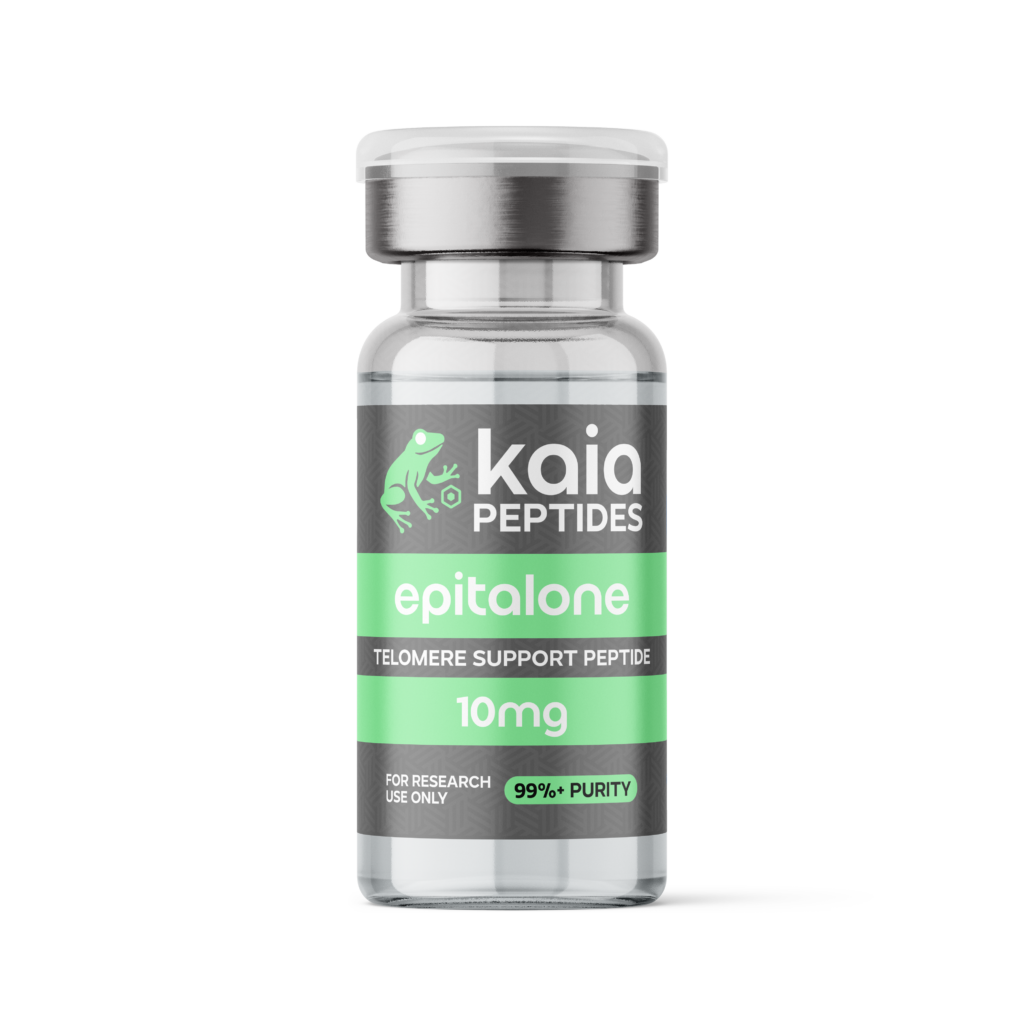
Epitalone (10mg)
Telomere-Pathway Research Peptide – Cellular-Aging Models, Circadian Signaling & Stress-Response Studies
For laboratory research use only. Not for human or animal use. These products have not been evaluated by the U.S. Food and Drug Administration (FDA) and are not intended to diagnose, treat, cure, or prevent any disease.
What Is Epitalone?
Epitalone (Epitalon) is a synthetic peptide modeled after a naturally occurring compound associated with the pineal gland. In scientific and laboratory research, it is frequently used to explore:
-
Telomere-maintenance pathway behavior
-
Cellular aging and senescence models
-
Antioxidant-related signaling
-
Circadian-rhythm regulation mechanisms
-
Stress-response and adaptation patterns
Researchers study Epitalone for its ability to interact with telomere biology, gene-expression frameworks, and time-regulated cellular processes in controlled environments.
Understanding Epitalone — A Metaphorical Research Analogy
Imagine a massive library used by researchers as a symbolic representation of genome and cell-aging models.
Each book in this library represents a cell’s DNA.
At the end of every book is a bookmark, symbolizing the telomere that protects the integrity of each “chapter.”
Every time a book is checked out (cell division), a tiny amount of wear occurs on the bookmark.
As this process repeats, bookmarks may shorten, leading to:
-
Damaged chapters
-
Torn pages
-
Reduced readability
-
Library-wide aging
Researchers use Epitalone to explore how telomere-related pathways behave when a “specialized librarian” enters the environment.
• Epitalone Strengthens the Bookmarks (Telomere-Pathway Study)
In this analogy, Epitalone represents a signal that:
-
Helps maintain bookmark stability
-
Supports telomere-related pathway activity
-
Preserves chapter integrity in experimental models
This helps researchers observe how telomere maintenance correlates with cellular-aging processes.
• Slowing Wear-and-Tear (Aging-Model Regulation)
As books are repeatedly handled, their structure weakens.
Epitalone is studied for:
-
Regulating cell-cycle timing
-
Influencing senescence-related markers
-
Maintaining genomic stability
This metaphorically keeps the books stronger for longer within the research library.
• Improving the Lighting System (Antioxidant-Signaling Research)
Strong, stable lighting in a library represents:
-
Lower oxidative-stress environments
-
Cleaner internal cellular conditions
-
Reduced ROS-related damage
Epitalone is researched for its relationship to antioxidant pathways and oxidative-stress modulation.
• Resetting the Opening Hours (Circadian-Rhythm Models)
When a library keeps unpredictable hours, disorganization grows.
Epitalone is examined for:
Researchers evaluate how these rhythms influence aging and repair models.
• Supporting an Organized Library (Stress-Adaptation Studies)
A calm, well-managed library ages more gracefully.
In stress-response experiments, researchers study Epitalone for:
-
Homeostasis-supporting signals
-
Cellular resilience behavior
-
System-wide stability under stress
This analogy represents maintaining an orderly, adaptive experimental environment.
Combined Research Perspective
In laboratory studies, Epitalone helps scientists explore:
-
Telomere-maintenance mechanisms
-
Cellular-aging and senescence pathways
-
Antioxidant-signaling effects
-
Circadian timing regulation
-
Stress-response and adaptation models
-
Multi-layer interactions affecting longevity research
The library analogy illustrates these mechanisms without implying any medical or human-use outcome.
For Research Use Only.
Not for human consumption. Not for medical, therapeutic, or veterinary use.
Descriptions are for scientific, laboratory, and educational reference only.