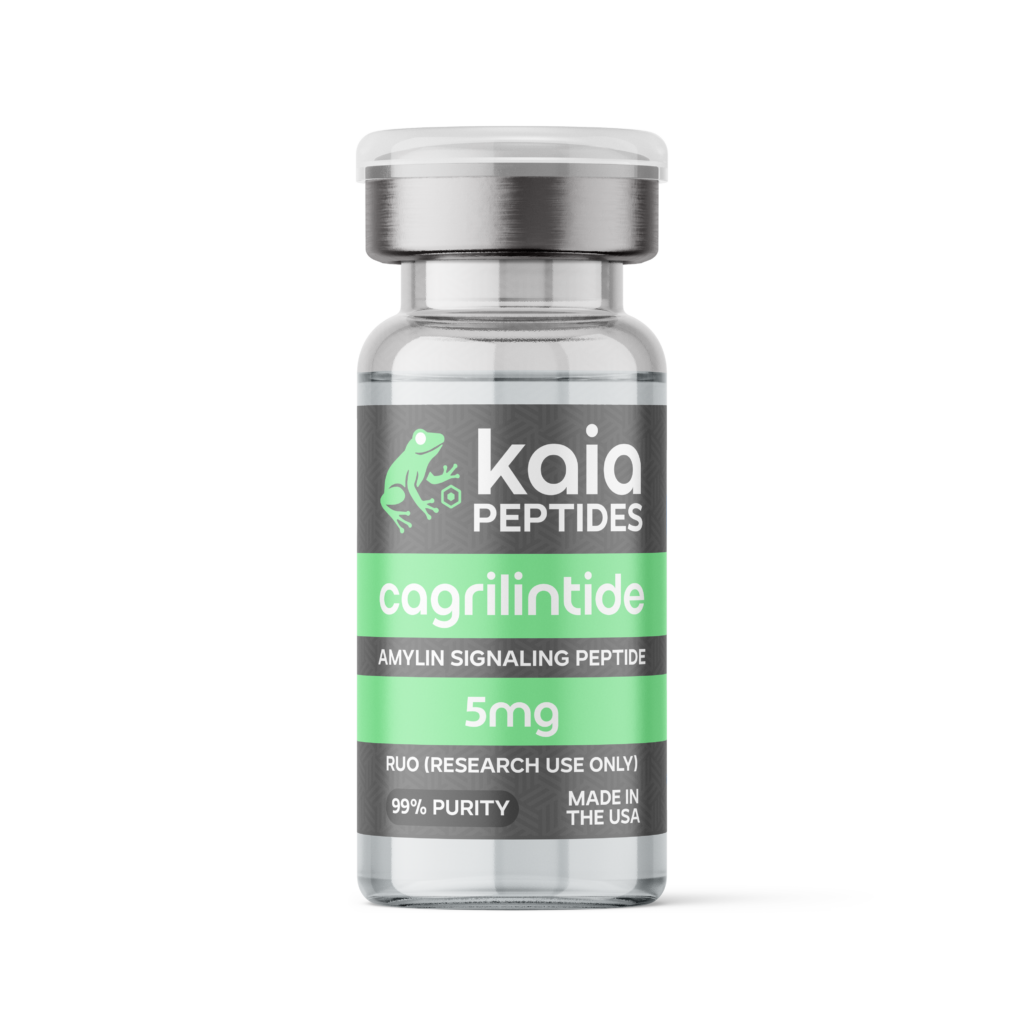
Cagrilintide

$ 125

Quantity

Product Discription

Cagrilintide (5mg)

Amylin-Mimetic Peptide – Satiety, Appetite Regulation & Metabolic Balance

What It Is

Cagrilintide is a long-acting amylin analog researched for its ability to:

● Regulate appetite and fullness
● Slow gastric emptying
● Support healthy metabolic signaling
● Reduce caloric intake in animal models
● Enhance satiety through CNS pathways

It works through amylin receptors rather than GLP-1, making it a powerful complementary pathway in metabolic research.

Understanding Cagrilintide — A Metaphorical Story

Imagine your appetite as a busy restaurant.

Food comes in, cooks get overwhelmed, and the line to order gets longer and louder.

When the restaurant is chaotic:

● Customers (hunger signals) rush in
● Orders pile up
● Meals go out too fast
● People ask for seconds
● The kitchen never gets a break

Your body feels this chaos as:

● Overeating
● Constant cravings
● Faster stomach emptying
● A weak “fullness” signal
Now imagine a new restaurant manager arrives — calm, organized, firm.

That manager is Cagrilintide.

• Cagrilintide Controls the Door (appetite regulation)

It doesn’t shut the restaurant down —it simply slows how many customers are allowed to enter at once.

The hunger line outside moves more calmly and predictably.

• It Speaks to the Dining Room (satiety signaling)

Cagrilintide sends a clear message:

“You’re full. You’ve had enough. Take your time.”

This represents its activity in satiety centers in the brain.

• It Slows the Kitchen (gastric emptying)

Meals aren’t rushed out anymore.

Food stays in the “stomach kitchen” longer, giving the body time to register fullness. This makes overeating far less likely.

• It Reduces Noise & Chaos (central appetite suppression)

The restaurant becomes quieter.

Less pressure.
Fewer cravings.
More control.

This is how Cagrilintide supports metabolic regulation in research studies.

The Result: A Calm, Efficient Appetite System

With Cagrilintide directing the flow:

● Hunger signals slow down
● Fullness signals strengthen
● Meals stretch longer
● Cravings shrink
● The entire “restaurant system” operates in balance

This is the simplest visual way to describe how Cagrilintide supports appetite and metabolic research.

Explore

Discover Our Range of Peptide Solutions

ELEVATE

$ 135

Add to cart

WOLVERINE

$ 125

Add to cart

GLOW

$ 175

Add to cart

Tesamorelin

$ 155

Add to cart

PULSE

$ 175

Add to cart

Sermorelin Acetate

$ 110

Add to cart

KPV

$ 100

Add to cart

Cagrilintide

$ 125

Select options This product has multiple variants. The options may be chosen on the product page

KLOW

$ 185

Add to cart

CJC-1295 (No DAC)

$ 100

Add to cart

AOD 9604

$ 105

Add to cart

SS-31

$ 250

Add to cart

Epitalone

$ 95

Add to cart

Semax

$ 175

Add to cart

Retatrutide

Price range: $ 200 through $ 700

Select options This product has multiple variants. The options may be chosen on the product page

NAD+

Price range: $ 100 through $ 200

Select options This product has multiple variants. The options may be chosen on the product page

FAQs

Find answers to your most pressing questions about peptide categories and their usage.

 
What is Cagrilintide +
Cagrilintide is a long-acting amylin analogue studied for its interaction with appetite-regulation and metabolic pathways. Researchers explore it as a type of “signal peptide” that may influence satiety circuits in preclinical models — like dimming the volume on hunger signals.
How does Cagrilintide work in research models? +
Animal studies show that Cagrilintide interacts with amylin receptors, which play roles in: ● satiety signaling ● gastric emptying ● energy intake regulation Think of it as a “brake pedal” researchers examine to understand how organisms naturally slow down food intake signals.
Why is Cagrilintide often paired with GLP-1 analogs in research? +
Because amylin and GLP-1 act on different satiety pathways, scientists study combinations to observe whether dual-pathway signaling creates amplified or complementary effects. It’s like testing how two different switches control the same room’s lighting.
What makes Cagrilintide different from Semaglutide or Retatrutide? +
● Cagrilintide → amylin receptor pathway ● Semaglutide → GLP-1 receptor pathway ● Retatrutide → triple agonist (GLP-1 / GIP / glucagon) Each targets different “control centers” within metabolic regulation — like different knobs on a soundboard.
Is Cagrilintide the same as Amylin? +
No. Cagrilintide is a synthetic analogue designed to mimic core functions of amylin, but with a much longer half-life in research studies. It’s the difference between a short burst of signal vs. a steady, sustained note.
What does research suggest about Cagrilintide and appetite? +
Preclinical studies show changes in: ● caloric intake ● food reward pathways ● satiety signals Researchers look at it like observing how adjusting a thermostat affects an entire climate system. (All findings refer strictly to animal and in-vitro models.)
Why is Cagrilintide considered “long-acting”? +
Its molecular design allows it to remain active for extended periods in research subjects. Imagine a slow-release message that continues to influence the system long after it’s delivered.
How does amylin signaling influence digestion in research? +
Amylin receptors are tied to gastric emptying — essentially how fast food leaves the stomach. Researchers use Cagrilintide to observe how delaying this process affects metabolic patterns, like slowing down a conveyor belt to analyze each item passing by.
What areas of metabolic research use Cagrilintide? +
Scientists study it in contexts such as: ● appetite regulation ● obesity models ● combination-therapy exploration ● energy balance pathways It helps model the “upper layers” of metabolic control — the decision-making signals, not the mechanical digestion.
How does Cagrilintide compare to older amylin analogs like Pramlintide? +
Cagrilintide has a longer half-life in research settings and appears more potent in preclinical data. If Pramlintide is a short text message, Cagrilintide is a long voicemail — more sustained, more noticeable.
Is Cagrilintide safe in preclinical research? +
Animal studies report favorable safety under studied conditions, but Cagrilintide is: ● Not FDA-approved ● Not for human consumption ● Strictly for laboratory research only Kaia follows full research-use compliance.
How should Cagrilintide be stored for stability? +
Store sealed, cool, and protected from light. Refrigerate for short-term use and freeze for long-term preservation. Peptides behave like delicate reagents — they stay structurally sound when kept cold and undisturbed.